

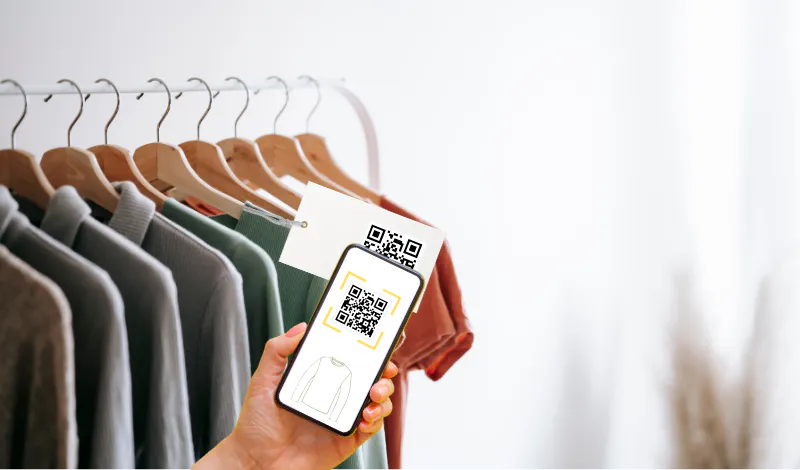
The implementation of garment-level RFID has been quietly running in the background of major retail operations for over two decades. What’s changed is its visibility. A handful of retailers have put item-level RFID directly in front of millions of shoppers, and each has taken a different route to get there. Here’s how Decathlon, Zara, Uniqlo, Marks & Spencer and H&M use the technology, and what the results show.
Decathlon: the long game
Decathlon’s RFID programme began with a trial in France in 2008. By 2014, it was embedded in core business processes, and by January 2019, the company had reached 100% of products tagged worldwide, with RFID readers operating across every stage of the value chain, from factory floor to checkout. The self-checkout experience is what most customers notice: a full basket placed on a reading surface, every item detected at once, no individual scanning. But the bigger win has always been supply chain visibility. With every garment carrying a unique identity from manufacture onward, Decathlon can track stock with a precision that barcodes simply can’t match, supporting faster, more accurate restocking across its global store network.
Marks & Spencer: two decades of data
M&S has the longest continuous RFID programme of any UK clothing retailer, and one of the best-documented. The retailer began trialling RFID on men’s suits in 2003, expanded across hundreds of UK stores through the early 2010s, and by 2017 had reached close to full RFID coverage of its clothing range, using over 100 million tags a year at one stage and 350 million annually more recently. Richard Jenkins, M&S’s head of RFID and loss prevention, has reported that SKU-level stock accuracy rose from 68% in 2014, when the rollout extended to the full product range, to 91.5% by the second half of 2021.
That kind of longitudinal improvement is the clearest evidence of what sustained RFID investment delivers. M&S’s position as a largely own-brand, vertically integrated retailer let it tag products at source from the outset, removing one of the biggest barriers other retailers face when bringing suppliers on board.
Photograph: Bestravelvideo / Shutterstock.com
H&M: RFID as a recovery tool
H&M expanded RFID to around 1,800 stores across 12 countries from 2018, at a point when the retailer was under real pressure to bring unsold inventory under control. The rollout of RFID improved stock accuracy, reduced end-of-season markdowns and lifted the proportion of full-price sales, supporting a broader shift toward real-time inventory management across H&M Group’s store network.
Zara (Inditex): built for speed
Inditex rolled out RFID across Zara between 2014 and 2016, before extending it to sister brands including Massimo Dutti, Pull&Bear and Bershka. Inditex president Pablo Isla has described RFID as a positive change “in the way we operate the stores from every point of view.” For Zara, the technology underpins the brand’s defining advantage: speed. Store and head office teams can see, almost in real time, which styles and sizes are selling where, supporting redistribution between stores and markdowns that target genuinely slow-moving stock rather than applying blanket discounts.
Uniqlo: infrastructure first, checkout second
Fast Retailing began embedding RFID into price tags from around 2017, across Uniqlo and sister brands Theory and Helmut Lang. Fast Retailing’s CIO Takahiro Tambara has been clear that the goal was never simply to speed up checkout. It was to build a data platform usable across the entire supply chain, with the now-familiar self-checkout experience standing as the most visible, customer-facing layer of that infrastructure.

Photograph: Uniqlo
The independent evidence behind the trend
Individual retailer figures tell part of the story. The clearest picture of RFID’s impact across the sector comes from independent research published by GS1 UK in 2018, authored by Professor Adrian Beck of the University of Leicester, drawing on interviews and performance data from ten retailers and brands including Adidas, C&A, Decathlon, Lululemon, Jack Wills, John Lewis, Marc O’Polo, Marks & Spencer, River Island and Tesco. The study found that RFID adoption was associated with sales increases of up to 5.5%, with seven of the ten retailers studied seeing improvements of between 1.5% and 5.5%. Inventory accuracy improved by more than 50% across the sample, with retailers reaching 93 to 99% accuracy once RFID was fully embedded. It remains the most robust cross-retailer evidence available on what garment RFID delivers in practice.
What sets the leaders apart
Looking across Decathlon, M&S, H&M, Zara and Uniqlo, the pattern is consistent. Each treated RFID as supply chain infrastructure first, with checkout convenience as a visible by-product rather than the end goal. Each pursued full coverage rather than partial tagging, recognising that item-level tracking only delivers its full value once close to every product carries a tag. And each has now been running RFID long enough to generate genuinely longitudinal results, not early-stage pilot figures.
Photograph: Vogue
Where Digital Product Passports change the picture
As the EU’s Digital Product Passport requirements for textiles move through the legislative process, the tagging infrastructure these retailers have already built becomes even more valuable. The same unique item identifier that powers fast checkout and accurate stock counts can carry, or link to, the sustainability, material and traceability data a DPP will require. Retailers with item-level RFID already in place have a head start. Those still relying on barcodes have further to travel.
This is exactly the territory we explored on RFID Unlocked, where Philip Leslie sat down with Mark Tailford of RFID Threads to discuss embedded RFID’s role in protecting brands from counterfeiting and enabling full product life-cycle visibility, themes that sit at the heart of where garment tagging is heading next. You can listen here.
Sources:
- Decathlon Sustainability: “Product traceability and RFID technology at DECATHLON” — https://sustainability.decathlon.com/product-traceability-and-rfid-technology-at-decathlon
- GS1 US case study: “Global Retail Sporting Goods Leader Finishes First with RFID” — https://www.gs1us.org/industries-and-insights/case-studies/decathlon
- RFID Journal: “Marks & Spencer Embraces Change” — https://www.rfidjournal.com/news/marks-spencer-embraces-change-2/74198/
- RFID Journal: “Marks & Spencer Expects to Achieve 100 Percent RFID-Tagging by 2017” — https://www.rfidjournal.com/news/marks-spencer-expects-to-achieve-100-percent-rfid-tagging-by-2017/73082/
- Retail Systems: “M&S ‘close to completing RFID rollout’ with beauty products” (source of the 68% → 91.5% accuracy figures, from Richard Jenkins at the Retail Technology Show) — https://www.retail-systems.com/rs/M&S_Close_To_Completing_RFID_Rollout_With_Beauty_Products.php
- Impinj: “Zara’s Retail Inventory Management System Drives Business” (source of the Pablo Isla quote) — https://www.impinj.com/library/blog/zaras-retail-inventory-management-system-driv
- RFID.org.ua case study: “Zara (Inditex) Global RFID Implementation in Fast Fashion Retail” — https://rfid.org.ua/projects/uhf-rfid-retail/projects-zara-inditex-rfid/
- Focus RFID: “What is the magic that makes UNIQLO choose RFID?” (source of the Takahiro Tambara quote) — https://www.focus-rfid.com/news/what-is-the-magic-that-makes-uniqlo-choose-rfid/
- GS1: “New report shows RFID delivers retail sales increase by up to 5.5%” — https://www.gs1.org/resources/articles/new-report-shows-rfid-delivers-retail-sales-increase-by-55
- Full GS1 report: www.gs1uk.org/rfidinretailing
Talk to Coriel: coriel-solutions.com/information/contact
Frequently Asked Questions
We're a retailer considering RFID for our garments — where do the biggest operational gains tend to come from?
The retailers with the strongest results consistently point to inventory accuracy as the primary driver of ROI, rather than checkout speed. Knowing exactly what you have, where it is and how it’s moving — in close to real time — reduces out-of-stocks, cuts unnecessary markdowns, and gives you the data to make smarter redistribution decisions across your store network. Checkout automation and loss prevention are significant additional benefits, but they tend to follow from the inventory foundation rather than lead it.
At what point in the supply chain should garments be tagged?
The retailers seeing the greatest benefit tag at source — meaning at the point of manufacture rather than in the distribution centre or store. Source tagging gives you visibility from the moment a garment exists, which is where the most valuable supply chain data is generated. It also removes a significant labour cost further down the chain. Retailers like M&S, which have their own-brand model and strong supplier relationships, were able to mandate source tagging early, and credit that decision as a key factor in the success of their programme.
How do we build the business case for garment RFID internally?
The most robust cases tend to be built around inventory accuracy improvement and its downstream effects — reduced out-of-stocks, fewer markdowns, lower labour costs in stocktaking, and stronger omnichannel fulfilment. Independent research from GS1 UK found that seven of ten retailers studied saw sales improvements of between 1.5% and 5.5% following RFID implementation, driven largely by stock accuracy gains. Framing the business case around those operational outcomes, with a phased rollout that allows ROI to be demonstrated at pilot stage, tends to be more persuasive than leading with the technology itself.
With EU Digital Product Passport requirements on the horizon, how does garment RFID fit into our compliance planning?
If you’re already building an RFID programme, you’re building the foundation for DPP compliance at the same time. The unique item identifier on an RFID tag can carry or link to the material, traceability and end-of-life data that incoming EU textile regulation will require. Retailers investing in item-level RFID now are avoiding a situation where they need to retrofit a compliance solution onto an existing infrastructure — the tagging architecture serves both operational and regulatory purposes from day one.
Useful links
Digital Product Passport Technical Guide
The 2026 Guide to Digital Product Passports
The 7 Questions That Decide Whether Your RFID Project Succeeds
Discover the key questions your business should address as you plan your RFID project
RFID Unlocked Podcast
Find out more about RFID in the first season of our podcast