

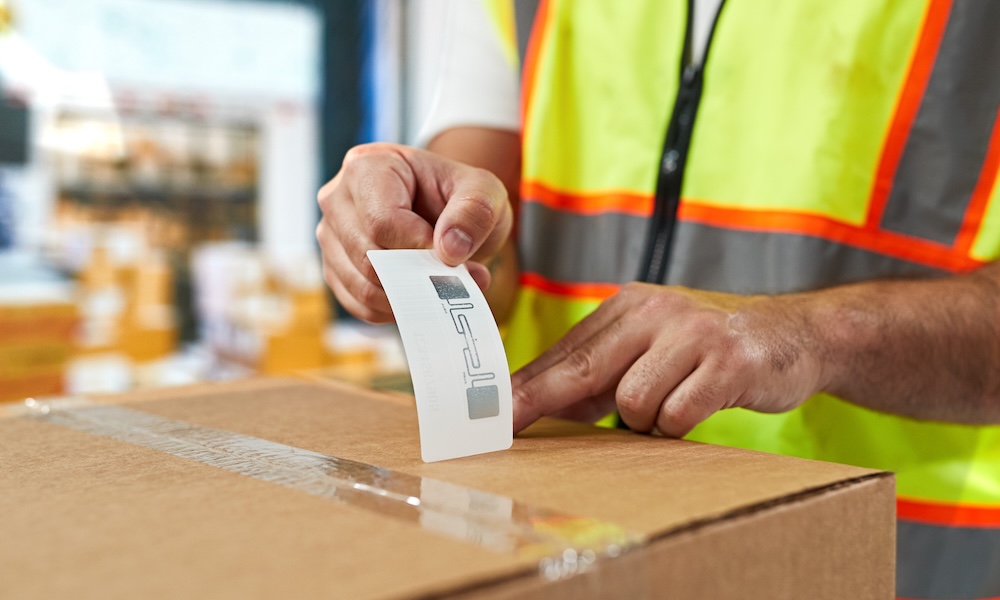
RFID proof of delivery is an idea the pharmaceutical industry has already validated at scale, and one that bulk retail is only now beginning to adopt. Pharmaceutical supply chains do not tolerate ambiguity about where a product is, whose hands it has passed through, or whether it arrived in the condition it left the warehouse. The system is built around a single organising principle: every movement of every item is recorded, verified, and accountable. The result is a chain of custody that can be interrogated at any point, in any direction, with complete confidence in the answer.
Bulk retail (furniture, outdoor structures, large appliances, and any category where a consumer purchase arrives in multiple parts), is reaching an inflection point where those same disciplines are no longer a nice-to-have. High-value items, long lead times, complex multi-drop delivery routes, and customers who have taken days off work to receive an order they have been waiting weeks for: the cost of getting it wrong is significant. A missed delivery means rescheduling. A damaged item means a claim. An incomplete order – a sofa delivered without its legs, a shed delivered without its fixings – means a failed installation, an unhappy customer, and an avoidable return. The operational and reputational cost of these failures accumulates quietly but relentlessly.
This post, the third in our series on RFID in bulk retail, looks at what furniture and large-format retailers can borrow from pharmaceutical supply chain practice, and how RFID, combined with structured proof of delivery, can bring the same level of traceability and accountability to a sector that has historically operated without it.
What pharmaceutical supply chains do differently
The pharmaceutical industry operates under legal obligations that make traceability non-negotiable. Serialisation requirements, in the EU under the Falsified Medicines Directive, and in the US under DSCSA, mean that every pack of medicine must carry a unique identifier and a verifiable history from manufacturer to dispenser. That regulatory pressure has produced something valuable beyond compliance: it has forced the sector to build supply chains in which accountability is not optional, and visibility is not approximate.
In practice, this means that at every point of handover, from manufacturer to wholesaler, from wholesaler to distributor, from distributor to pharmacy, the transaction is confirmed, recorded, and tied to a specific item identity. There is no concept of a ‘probably fine’ delivery. Either the item is verified, or the handover is not complete. Exception handling is built into the process: if a scan fails, or a count does not match, the system flags it before the delivery is accepted rather than after a complaint arrives.
Coriel Solutions has worked with pharmaceutical clients implementing exactly these kinds of end-to-end traceability solutions, and the discipline embedded in those systems is instructive. The question is not whether the technology is applicable to other sectors, it clearly is. The question is whether the operational will exists to apply it with the same rigour.
The bulk retail parallel: from ‘delivered’ to ‘delivered correctly’
In much of bulk retail today, ‘delivered’ is the end of the visibility chain. A driver completes a drop, a signature is obtained, and the system marks the order as closed. What that closure does not capture is whether every component of a multi-part item was on the vehicle, whether any damage occurred in transit, whether the correct configuration was loaded at the warehouse, or whether the customer’s signature was obtained under duress rather than satisfaction. When a claim arrives three days later, the business has little verifiable evidence to work with beyond the driver’s word and a photograph that may or may not be conclusive.
The pharmaceutical model reframes the question entirely. The goal is not to prove delivery happened; it is to prove that the right item, in the right condition, was handed to the right recipient at a specific time and location. Each of those elements, item identity, condition, recipient, time, location, is a discrete data point that must be captured and stored. When something goes wrong, the evidence already exists. The burden of proof shifts from a reactive scramble to a straightforward audit.
For bulk retailers, the translation is direct. A sofa has multiple components. Each can be individually tagged and verified at the point of loading, the point of departure, and the point of delivery. A shed arrives in a kit: panels, frame, fixings, instructions. If the fixings are missing because they were not loaded, the system should know before the vehicle leaves the depot, not when the customer calls to say they cannot complete assembly. That shift, from reactive complaint handling to proactive exception management, is the core of what pharma-style discipline offers.

What RFID captures, and why it matters
RFID-based proof of delivery goes considerably further than a barcode scan or a driver’s handheld confirmation. At each stage of the delivery journey, the system can capture the serial identity of the item or component, the precise time of the event, the location of the scan, and the identity of the handler. Combined, those four data points create an auditable chain of custody that mirrors the pharmaceutical model in everything except the regulatory mandate.
At the warehouse, RFID portals verify the full manifest against the pick list before a vehicle is released. Every item crossing the portal is read; anything missing or unexpected triggers an exception before departure. On the vehicle, load integrity can be confirmed at intermediate stops. At the customer’s home, a final scan confirms that everything on the manifest was present and handed over. Each scan creates a timestamped record. If a customer subsequently claims an item was missing or damaged, the retailer has a complete event log from pick to doorstep.
The value of this data is not limited to dispute resolution. Over time, it reveals patterns that operations teams can act on: which routes have the highest rate of exceptions, which products are most frequently associated with damage claims, which handlers are consistently accurate, and which are not. The chain of custody is also a source of operational intelligence, and retailers who treat it as such quickly find that the same system which reduces claims also reduces the root causes of those claims.
Reducing chargebacks and disputes with verifiable evidence
Delivery disputes are expensive in bulk retail in ways that go beyond the direct cost of the chargeback. There is the time spent by customer service teams investigating claims, the logistics cost of re-delivery or collection, the write-off on damaged or incomplete items, and the downstream impact on customer satisfaction scores and repeat purchase rates. Research across the wider retail sector consistently points to delivery experience as one of the most influential factors in whether a customer returns, and in bulky categories, where the purchase is considered and the delivery is an event in itself, a failed handover can end the relationship entirely.
When every delivery is backed by a complete digital record of what was loaded, when it left, where it was at each scan point, and what was confirmed at the door, the nature of disputes changes. Fraudulent or mistaken claims, where a customer genuinely cannot recall what was delivered, or in rarer cases makes a false claim, can be resolved quickly and with confidence. Legitimate claims, where damage or shortage is genuine, are equally straightforward to identify and act on. The system removes ambiguity from both sides of the conversation, which benefits the retailer operationally and the customer experientially.
Integrating POD data with TMS, WMS, and customer communications
The chain-of-custody data captured by RFID is most powerful when it flows into the systems that the business already relies on. A warehouse management system that knows every item was verified at dispatch can automate customer notifications. A transport management system that has real-time scan data from the vehicle can provide accurate delivery windows rather than the vague half-day slots that still frustrate customers across the industry. A customer service platform that can pull the full delivery event log instantly removes the need for an agent to chase a driver or a depot for information that should already be in the system.
This integration is where the pharmaceutical model is most instructive, because pharma has spent two decades building data architectures in which the product record travels with the product. The item identity created at manufacture is the same identity that is verified at every subsequent handover. There is no reconciliation problem, no data translation overhead, no moment where the chain breaks because one system does not talk to another. For bulk retailers building or upgrading their RFID infrastructure, starting with this principle – one identity, consistent across every system from pick to delivery confirmation, avoids the fragmentation that makes proof-of-delivery data difficult to use in practice.

Preventing the classic bulk delivery failures
It is worth being specific about the failure modes that RFID-based chain of custody addresses, because they are consistent across the sector and the cost of each one is higher than it might appear on first inspection. The wrong item being loaded happens when warehouse processes rely on human verification alone, a visual check or a manual count that confirms quantity but not identity. An RFID portal at the loading dock reads every tag automatically and flags immediately if an item does not match the manifest, regardless of how similar it looks to the correct one.
Missing components are perhaps the most damaging failure in the context of bulky items, because they render an otherwise complete delivery entirely unusable. A wardrobe without its hanging rail, a garden structure without its anchor bolts: the customer cannot use the product, and the retailer faces a secondary delivery to complete an order that should have been right the first time. Component-level tagging – where every sub-assembly in a kit is individually identified rather than just the outer carton, allows the system to verify completeness at pick and again at load, before the gap ever reaches the customer’s door.
Damage disputes arise most commonly when there is no evidence of condition at the time of delivery. Photographic capture at handover, timestamped and linked to the delivery record, addresses this directly, and when combined with RFID scan data that confirms the item was the correct one and arrived within the expected timeframe, it creates a record that is difficult to dispute on either side. The driver completes the delivery with confidence; the customer receives a clear digital record of what was delivered and when; and the retailer has an audit trail that removes the guesswork from any subsequent claim.
KPIs to track, and where to expect movement first
Businesses implementing RFID-backed proof of delivery should expect to see measurable movement in a relatively small number of metrics, and it is worth being clear about which ones matter most in the short term. Claims rate – the proportion of completed deliveries that generate a subsequent dispute or return, is the most direct measure of chain-of-custody effectiveness and typically shows movement within the first few months of deployment on high-value routes. Redelivery cost, which captures the combined logistics and handling expense of a second attempt, is closely related and often the larger number in pure financial terms.
First-time delivery success rate – the proportion of orders completed correctly on the first attempt, without a subsequent call, claim, or revisit, is the metric that most directly reflects the cumulative benefit of the system. It incorporates loading accuracy, route execution, and handover quality, and it is the number that connects most naturally to customer satisfaction outcomes. Retailers who begin tracking it before implementation, and continue through the rollout period, consistently find it the most useful indicator of whether the system is working as intended.

Where to start: a practical rollout approach
The pharmaceutical industry did not build its traceability infrastructure overnight, and bulk retailers should not expect to either. The most effective starting point is a focused deployment on high-value SKUs and multi-drop routes, where the cost of failure is highest and the ROI from improvement is most visible. A sofa at £1,500 that generates a delivery dispute costs the business considerably more than the original margin; starting the rollout with the products where that exposure is greatest concentrates the early benefit and makes the business case for expansion straightforward to make.
From there, the extension to multi-component products – kits, flat-packs, anything shipped in more than one carton, is a natural second step, because it is precisely here that the gap between current practice and what RFID enables is widest. Most retailers can tell you how many orders were delivered. Very few can tell you, with confidence, how many were delivered complete. Closing that gap is the core value proposition, and it is one that pharma has demonstrated can be delivered at scale, without compromising speed or adding meaningful cost to the operation.
The pharmaceutical supply chain did not become the model it is today because regulators demanded it, or not only for that reason. It became the model because the people running it recognised that accountability and efficiency are not in tension; they are complementary. A system that knows exactly where everything is, and can prove it, does not just reduce disputes. It reduces the operational conditions that cause disputes in the first place. That is the lesson bulk retail is now in a position to apply, and the technology to do it is already proven.
For retailers looking to improve delivery accuracy, reduce claims, and introduce greater control across fulfilment, Coriel Solutions works as a complete system integrator, applying proven approaches from regulated supply chains to bulk retail environments, from consultancy through to delivery.
Frequently Asked Questions
What is chain-of-custody tracking and why does it matter for furniture retail?
Chain-of-custody tracking creates a verified, timestamped record of every point at which an item changes hands – from warehouse pick, through loading and transit, to final delivery. In furniture and bulk retail, where orders are high value, multi-component, and difficult to redeliver, this level of accountability reduces disputes, prevents incomplete deliveries, and gives both the retailer and the customer a clear record of what was delivered, when, and in what condition.
How does RFID improve proof of delivery compared to a standard signature or barcode scan?
A signature confirms that someone was present; it does not confirm what was delivered. A barcode scan verifies a carton was scanned, but typically requires line-of-sight and manual effort for each item. RFID reads multiple items simultaneously and automatically, capturing the serial identity, time, location, and handler at each stage of the journey. The result is a complete delivery record that is far more detailed, far harder to dispute, and generated without adding meaningful time to the delivery process.
Can RFID track individual components within a multi-part furniture order?
Yes — and this is one of the most valuable applications in bulk retail. Rather than tagging only the outer carton or the order as a whole, component-level RFID tagging assigns a unique identity to every sub-assembly within a kit. This means the system can verify at the point of loading that every panel, fixing, and accessory is present before the vehicle leaves the depot, eliminating the most common cause of failed installations and avoidable redeliveries.
How difficult is it to integrate RFID proof-of-delivery data with existing warehouse and transport management systems?
Modern RFID solutions are designed to integrate with the WMS and TMS platforms that retailers already operate, feeding delivery event data directly into existing workflows rather than creating a separate system to manage. The key is establishing a consistent item identity from the point of pick — the same identifier that travels through the warehouse system should be the one verified at the door. Retailers who get this right find that customer notifications, delivery confirmation, and dispute resolution all become significantly faster and less resource-intensive as a result.
Useful links
RFID Revenue Levers for Bulk Retail
RFID That Pays for Itself: The Three Revenue Levers Bulk Retailers Can Pull in 90 Days
RFID and waste reduction in Bulk Retail
From Cost Centre to Control Tower: Where RFID Removes the Most Waste in Bulk Retail Operations
GS1 RFID Standards Overview
GS1 overview of EPC RFID standards and how to implement them